This article contains affiliate advertising (PR).
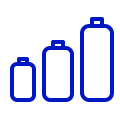
5,000 vs 10,000 vs 20,000mAh: Which Power Bank Capacity Should You Buy?
Power banks come in steps: 5,000, 10,000, 20,000mAh and up. Choose on “bigger is safer” and you end up with something too heavy to carry. The short answer: 5,000 for daily top-ups, 10,000 as a one-day safety net, 20,000 and up for travel or a laptop. The reason is that weight rises almost in proportion to capacity while what actually reaches your phone is less than the label. This guide lays out that mechanism, the charge counts and weights, and the airline rule so you can settle on your number.
The short answer: capacity by use
- Daily top-ups (5,000mAh class): Anker Nano Power Bank (5,000mAh, built-in USB-C connector)—plugs straight in, no cable. Pocket-sized. AmazonRakuten
- One-day safety net (10,000mAh class): Anker Nano Power Bank (10,000mAh, 30W, built-in cable)—the best-selling class. About two phone charges. AmazonRakuten
- Travel, 2–3 days (20,000mAh class): Anker Power Bank (20,000mAh, 30W)—about as large as stays easy to fly with. AmazonRakuten
- Laptop too (over 20,000mAh, high output): Anker Prime Power Bank (26,250mAh, 300W)—140W from one port. Under 100Wh, so cabin-friendly. AmazonRakuten
How to decide: how many charges → 60–70% of rated mAh actually arrives → weight tracks capacity → airlines allow up to 160Wh (about 43,000mAh).
Verification: guide figures from makers' official ratings and typical conversion efficiency (not measured).
The short answer: three mechanisms that settle the capacity question
| Question | What the mechanism says | So when you choose |
|---|---|---|
| How many phone charges from 10,000mAh? | The label is the cell capacity. Converting to 5V or 9V loses 30–40%. An iPhone battery is roughly 3,000–4,800mAh | About two charges from 10,000; just under one from 5,000; three to four from 20,000 |
| Why does bigger weigh more? | Cell weight is nearly proportional to capacity. Around 200g for 10,000mAh, around 400g for 20,000 | Carrying it daily → 10,000 or less. Occasionally → 20,000 |
| On a plane? | Up to 100Wh with no declaration; 100–160Wh with conditions; above 160Wh not allowed (Wh = mAh × 3.7 ÷ 1,000) | Up to the 27,000mAh class (about 100Wh) is stress-free; above that, check first |
Mechanism 1: only 60–70% of the label reaches your phone
A “10,000mAh” power bank means the cells inside (about 3.7V) hold that much. To hand it to a phone it’s stepped up to 5V or 9V, then stepped down to battery voltage inside the phone. Each conversion turns some energy into heat, and the cable takes a little more, so roughly 60–70% of the label actually enters the phone’s battery as a working guide (mAh vs Wh explained).
Decision: “two charges of a 4,000mAh phone” works out to 4,000 × 2 ÷ 0.65 ≈ 12,000mAh—so a 10,000 unit is borderline, and the next class up gives margin.
Mechanism 2: weight tracks capacity almost one-to-one
Cell weight is nearly proportional to capacity. Within one generation of cells, “double the capacity” is close to “double the weight,” and the case and circuitry don’t change that much.
| Class | Typical weight | Phone charges (guide) | Suits |
|---|---|---|---|
| 5,000mAh | around 100g | just under one | daily pocket carry, top-up until you’re home |
| 10,000mAh | around 200g | about two | a one-day safety net, business trips, day trips |
| 20,000mAh | around 400g | three to four | travel, emergency kit, tablets too |
| Over 20,000mAh, high output | over 500g | three to five plus a laptop | charging a laptop away from a desk, long days out |
Weights are typical of makers’ official figures; individual products vary.
Decision: a power bank you don’t carry is worthless, so for daily carry stay at 10,000 or below. The 20,000 class suits travel and emergency kits, where it has a fixed home (lightweight power banks compared / high-capacity power banks compared).
Mechanism 3: airlines cap at 160Wh (about 43,000mAh)
Aircraft rules are in Wh (watt-hours). Wh = mAh × 3.7 ÷ 1,000, so 10,000mAh ≈ 37Wh, 20,000mAh ≈ 74Wh, 27,000mAh ≈ 100Wh. Up to 100Wh needs no declaration; 100–160Wh is allowed with airline conditions; above 160Wh is not allowed. Checked baggage is out; carry-on only (power banks on planes).
Decision: for travel, stay within the 27,000mAh class (about 100Wh). Laptop-class banks such as 26,250mAh are built to sit inside that range.
Semi-solid-state cells and “harder to ignite” claims
Since 2025 more power banks use semi-solid-state cells, which solidify part of the electrolyte to make ignition less likely. The capacity logic (60–70% usable, weight tracks capacity) is unchanged. Read safety claims alongside the PSE mark (choosing a safe power bank: PSE).
Decision table: who it suits, who it doesn’t, how it fails
| Class | Suits | Doesn’t suit | Failure condition |
|---|---|---|---|
| 5,000 | lightest possible, daily | a full day out | buying it expecting two charges |
| 10,000 | most people | 2–3-day trips, laptops | picking a thick unit without checking weight |
| 20,000 | travel, emergencies | daily carry | output too low for a laptop |
| Over 20,000, high output | laptops, long days | anyone prioritizing weight | over 160Wh, so not allowed on board |
Products that follow the mechanism
5,000mAh, built-in connector: plugs straight into the phone.

Anker Nano Power Bank (5,000mAh, built-in USB-C connector)
10,000mAh, built-in cable: the staple of the best-selling class.

Anker Nano Power Bank (10,000mAh, 30W, built-in USB-C cable)
20,000mAh class: for travel and emergency kits with a fixed home.

Anker Power Bank (20,000mAh, 30W)
Over 20,000mAh, high output: laptops included, still within cabin limits.

Anker Prime Power Bank (26,250mAh, 300W, 140W single port)
FAQ
Q. Can 5,000mAh fill an iPhone? A. At 60–70% usable that’s about 3,000–3,500mAh delivered. Taking an iPhone (about 3,000–4,800mAh by model) from 0 to 100% is a stretch; think of it as “a top-up until you’re home.”
Q. Do MagSafe (wireless) banks deliver less at the same capacity? A. Yes—wireless adds transfer loss, so the same label delivers less than a wired bank (MagSafe vs wired power banks).
Q. One big bank or two small ones? A. If you split daily use and travel, “5,000 + 20,000” is practical. For a single unit, 10,000 is the compromise.
Sources (primary)
- Airline and regulator lithium-battery rules (the 100Wh / 160Wh bands) are linked as primary sources in power banks on planes
- Anker official product pages “Anker Nano Power Bank (30W, Built-In USB-C Cable)” and “Anker Power Bank (10000mAh, 22.5W)” (rated capacity and weight)
- Capacity mechanism: mAh vs Wh / how a lithium-ion battery works
Summary
- Only 60–70% of the label arrives. Work out the mAh you need as “charges wanted ÷ 0.65.”
- Weight tracks capacity. Daily carry: 10,000 or less. Travel and emergencies: 20,000.
- Airlines: 160Wh max, carry-on only. Up to the 27,000mAh class (about 100Wh) is easy.
Related: 10,000mAh power banks compared / light MagSafe power banks / laptop power banks compared / Anker power banks compared
This article compares products based on public specifications and trends in customer reviews (not hands-on testing by our team). Prices, availability, and review counts change, so please check each product page for the latest. About us: About
As an Amazon Associate, Tokyo Gadget earns from qualifying purchases. This site also participates in other affiliate programs.